
Setting Up Goals & Automations
Goals and automations give you a structured way to track and change specific habits.
Goals track your progress against a time target and show up in your reports and the Assistant. Automations fire a real-time notification and trigger actions (i.e., blocking distractions or opening a webpage) the moment a threshold is crossed. Both are found under Goals & Automations in the top navigation.
What goals track
A goal sets a daily time target (more than or less than a given amount) for a specific type of activity. Once created, your progress is tracked in the Goals report, on the Dashboard, and in the Assistant. You can also attach automations to a goal to get a notification, or trigger an action, when the goal is at risk or when you hit it.
You can set a goal for any of the following:
- A productivity level: e.g., more than 3h on Focus Work
- A category or sub-category: e.g., less than 30m on Social Networking
- A specific app or website: e.g., less than 1h on YouTube
- Total logged time: e.g., more than 5h total work
- A Timesheets project or client: e.g., more than 2h on a specific project (see Project goals)
Free accounts are limited to one goal. Upgrading unlocks unlimited goals, plus automations and advanced scheduling filters.
Creating a productivity goal
Go to Goals & Automations → Goals tab and click + New Goal. Select the For Focus tab.
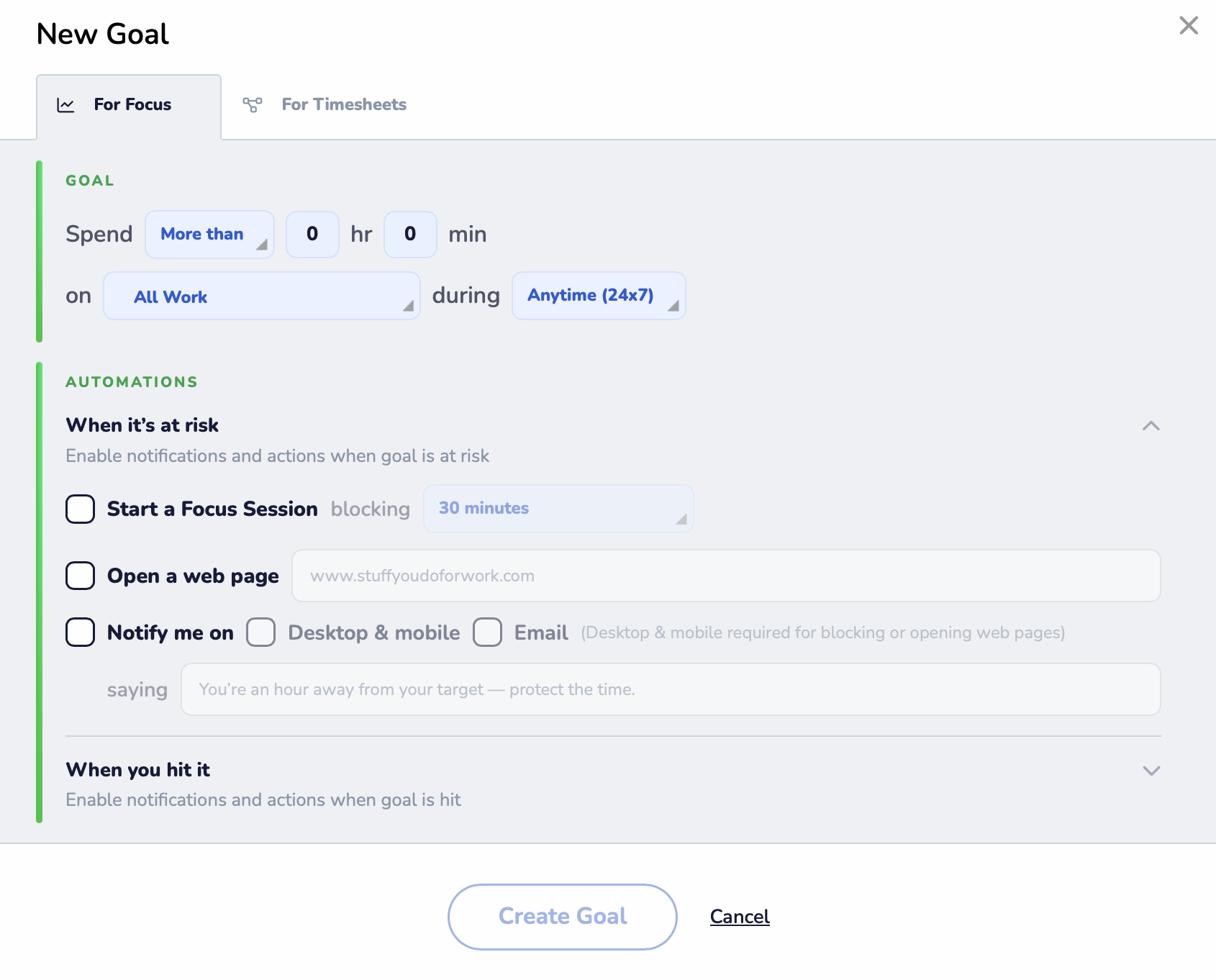
💡 You can also create a goal directly from any report. Click the Create an automation or goal button on any activity report to create a goal for that activity.
Adding automations to a goal
Every goal has an Automations section in the New Goal modal, below the goal itself. This is where you turn a goal from something you check into something that acts on its own. There are two moments you can automate, and you can use either one or both:
Expand either one and you get the same three options:
- Start a Focus Session: blocks distracting apps and sites for the length you choose
- Open a web page: opens a URL you enter, like your task list or the work you meant to be doing
- Notify me on: sends a notification to desktop & mobile, email, or both, with an optional custom message
Desktop & mobile notifications are required for blocking or opening web pages. Email alone can't start a Focus Session or open a page.
Creating a project goal Timesheets
If you use Timesheets, you can set a goal for a specific project or client. Click + New Goal and select the For Timesheets tab.
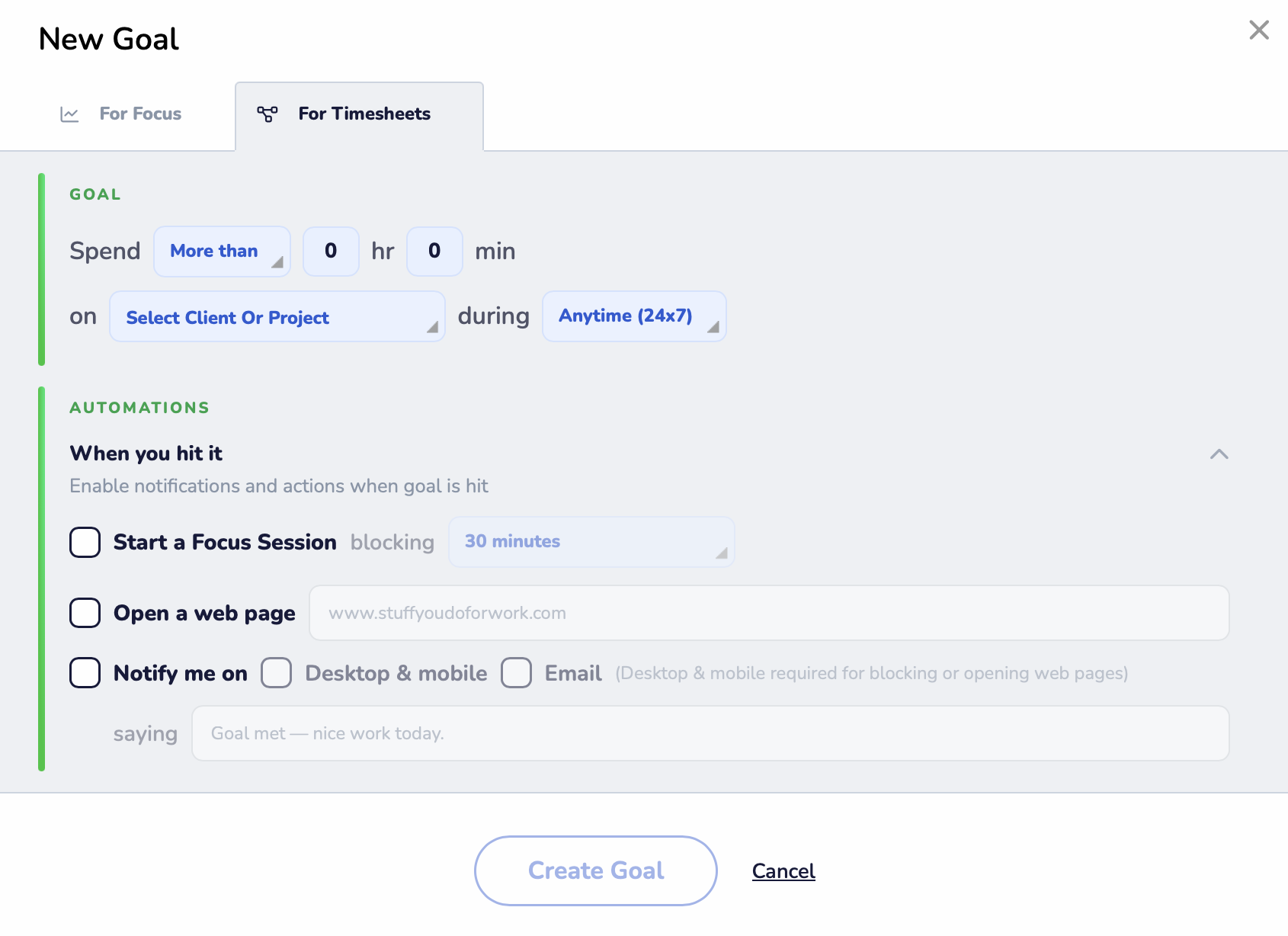
Choose your project or client from the dropdown, set a time target per day, and select a timeframe. Project goals track time that has been reviewed and logged in Timesheets. Timesheets goals can include automations that trigger when the goal is reached, but not automations for an at risk goal.
Project goals use Timesheets data only. They track logged project time, not general RescueTime activity. If your goal looks empty, make sure you've reviewed your timeline for that day and logged time to projects.
The Focus Work Goal and the Assistant
The Assistant displays one goal as a live progress bar at the top of its daily view. By default, this is your Focus Work Goal, the daily Focus Work time target set in your Work Schedule settings.
You can replace it with any goal by clicking the star icon on a goal card. This sets it as your daily Assistant goal. Only one goal can be selected at a time.

Changing your daily Focus Work Goal
The Focus Work goal shown in the Assistant by default is set in Account Settings → Work Schedule. You can set it manually to any value between one and 6 hours, or link it to an existing productivity goal from your goal list.
Setting the daily Focus Work Goal to "from productivity goals" and selecting a specific goal from your list lets you focus on your most important goal.
Tips for setting goals
Be specific when it makes sense
If you want to cut down on email, don't set a goal for "less time in Communication & Scheduling", set it for email specifically, or for your primary email app. The more specific the activity, the more actionable the goal.
Go broad when your work spans many apps
If your meaningful work happens across many different apps, like writing in Notion, coding in VS Code, and designing in Figma, setting a goal for a productivity level like Focus Work captures all of it at once.
Use timeframes to add context
A goal scoped to Work Hours is very different from the same goal scoped to Anytime. Someone trying to limit social media time during work probably doesn't want weekend activity to count against them. Use timeframes to make your goals match the behavior you're actually trying to change.
Start realistic
Check your current daily averages in the Apps & Websites or Productivity report before setting a target. Aiming for a 10–20% improvement from where you currently are tends to work better than setting an aspirational goal you immediately fall short of.
How automations differ from goals
Goals and automations both track your time against a threshold, but they work differently:
| Goals | Automations | |
|---|---|---|
| Tracks progress | ✓ | ✓ |
| Shows on Dashboard | ✓ | ✗ |
| Email or desktop notification | Optional | Required (desktop or email) |
| Trigger a Focus Session | ✓ | ✓ |
| Open a website when triggered | ✓ | ✓ |
| Custom message when triggered | ✓ | ✓ |
| Repeatable per day | ✗ | ✓ |
| Available for free accounts | 1 goal | ✗ |
Use goals for tracking long-term trends and progress. Use automations when you want a real-time nudge the moment a threshold is crossed. Automations are especially useful for "less than" limits where you want to catch yourself before going too far.
Creating an automation
Go to Goals & Automations → Automations tab and click + New Automation.

Configure the automation:
Windows users: RescueTime automations use the Windows notification system. Make sure notifications are enabled in your system settings, or you won't see automation notifications.
Managing goals and automations
From the Goals & Automations page, you can edit, delete, or create new entries. Each goal card also shows you your current day's progress and gives you access to a few useful actions via the icons on the right:
- Bar chart icon: opens the full Goals Report filtered to that goal
- Timer icon: opens a real-time timer widget that tracks your progress toward the goal live, updating on screen as you work
- Edit icon: edit the goal's settings
- Delete icon: remove the goal
- Star icon: set this goal as the one displayed in the Assistant
The Goals Report
Click the goals report icon (the bar chart icon) on any goal card to see your progress over time. The report shows each goal's daily totals across your selected date range.
At a glance you can see which days you hit the goal and which you missed. This is useful for spotting patterns in when you tend to fall short. Zoom out to month or year views to see longer-term trends.
Viewing a specific day shows a bar chart of progress throughout that day, broken down by time of day, so you can see not just whether you hit the goal, but when during the day you made the most progress.